• Product
  • Automated Text Messaging

SMS Automation

Text-enable your marketing for instant reach
and greater impact

What Is SMS Automation
(Text Automation)?

SMS Automation allows you to send SMS messages to your contacts automatically without you having to manually compose messages for SMS campaigns and other consumer engagement. The power of SMS Automation lies in how it helps remove as much human error as possible while also freeing you to focus on higher-level or time-consuming tasks that require more effort or more attention.

The Trum·pia Advantage

Automated Workflows

Trum·pia's automation tools allow you to set your text automation campaigns to run themselves. The software automatically carries out predetermined tasks for you whenever a specified trigger or condition is met.

Top Use: Automatically branch text conversations down different messaging paths based on how they respond to your prompts. This allows you to answer common questions and send the correct information or links to contacts without tying up your employees on the phone.

Personalized Customer Journeys

Trum·pia takes pride in something none of our competitors offer—Personalized Customer Journeys. Our platform is more than just a collection of independent tools, opting instead for an approach that values the lifecycle of a customer or subscriber in its entirety, helping you build lasting relationships and leading to higher sales and repeat business.

Top Use: Our 7-Step Journeys allow you to handle every stage of the customer lifecycle—from contact collection to nurturing, support, the feedback loop, and re-engagement. This holistic approach yields far greater results than a spot promotion, event, or visit.

Smart Targeting

To stand out from the crowd, it's increasingly important to cater to your customers' growing desire for more personalized and relevant messages. Our Smart Targeting lets you sort contacts into separate distribution groups based on any criteria you want, from customer demographics and specific interests to their interactive behavior with our system.

Use Smart Targeting to only send automated text messages to the right customers and reduce the headache of sorting them yourself, saving you valuable time. It also helps protect your company's brand image, rather than annoying people with unwanted, irrelevant messages.

Top Use: Set up Dynamic Targets to keep your filtered distribution lists organized in real-time automatically updating whenever a new subscriber is added, a contact unsubscribes, or an existing profile gets updated. Try this to save time and eliminate the pain of manually updating lists one at a time yourself.

Top Use Case: Dynamic Targets

A university may opt in their entire incoming class of freshmen. In the following year, they would need those lists to be updated so those contacts are now listed as sophomores since there will be a new group of freshmen. Dynamic Targets do this so you save time and don't have to manually add, remove, or update records yourself.

What Are Automated Text Campaigns?

Automated Text Campaigns vary in their complexity and can be broken down into 3 levels.

  • Basic SMS automation icon

    Basic SMS Automation

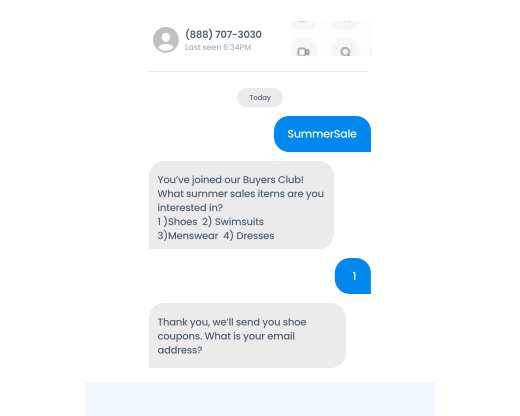
    In its most basic form, an automated text campaign is a follow-up sent automatically whenever a subscriber takes an action. A common example of this is sending a message when someone texts your keyword. Most software vendors consider this "automation," but it is only the beginning for Trum·pia and our SMS automation tools.

  • Drip campaign chart shows how you can send messages to your contacts at specific intervals

    Intermediate SMS Automation

    This next level incrementally sends text messages to a subscriber at specific times, such as a day, week, or month after they texted your keyword. We go beyond presets by allowing users to dynamically adjust their campaign flow based on subscriber actions. Without this, subscribers could get annoyed with unnecessary messages. That is why time is just 1 of 18 variables for our automated campaigns.

  • Automated SMS workflow chart

    Advanced SMS Automation

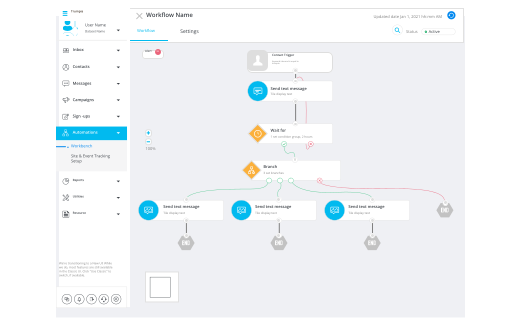
    What sets Trum·pia's automation apart is our advanced automation capabilities that are truly unique in the industry. Our automated workflows branch down diverging paths based on specific responses, subscriber actions (e.g., clicking a link, submitting a form), response quality (positive or not), and a multitude of other criteria. This unique advantage leads to:
    • Marketing campaigns tailored and engaging to the subscriber
    • Minimized opt-outs
    • Taking the Relationship to more steps
    • Maximizing the customer's lifecycle with your business

Basic Types of Automated SMS Messages

The following are a few examples of basic automated SMS Messages.

SMS Drip Campaigns
SMS Drip Campaigns

SMS Drip Campaigns

One type of SMS automation we offer at Trum·pia is called an SMS drip campaign. This type of automation sends messages at set time intervals or whenever an action is taken. Therefore, by designating the message response and the timing of the message, you can control every aspect of the campaign while maximizing your results. Our software even stops or creates new messaging paths based on the messaging paths you create!

Key Function: Drip campaigns allow you to remain in contact with your audience while saving valuable time via automation.

Text Auto Responses
Text Auto Responses

Text Auto Responses

Text Autoresponders automatically send a text in response to contacts who opt-in via your mobile keywords. Text auto replies are typically sent to customers to confirm their subscriptions to a mass texting service. Some businesses use text auto responses to provide information to customers, like sending them their store hours. Other businesses use text auto responses to drive customers to remain engaged by asking them questions. Conversion rates are driven by informed customers.

Trum·pia goes beyond simple text auto responses by offering dynamic and automated features that do more than just send a static message. Send automated SMS messages that don't feel "automatic."

Key Function: With our text auto responder, you can start an automated campaign that asks customers questions and captures their responses so that you can use this information to personalize your messaging.

Scheduled Text Messages
Text Auto Responses

Scheduled Text Messages

Scheduled text messages are messages you set to be sent at a later time. With a mass texting software like Trum·pia, scheduling your message is hassle free. Simply:

Compose your message

Choose the recipients

Select the option of when you want to send it

Freely edit or cancel the message at any point before it sends

One way to improve this feature is to use a dynamic list that updates instead of a static list to send the scheduled messages. Imagine how much more effective your offers could be if 100 more subscribers now qualified to receive a scheduled message, but they signed up and qualified after the message was already scheduled.

Key Function: Use scheduled auto text messages for sending appointment reminders, event invites, product updates (e.g., item restocks), and so much more. With high open rates, texts are ideal for ensuring your audience receives targeted information.
Recurring Messages
Text Auto Responses

Recurring Messages

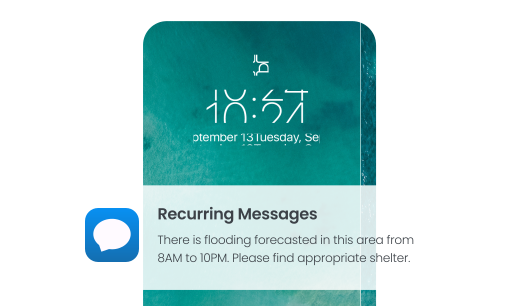
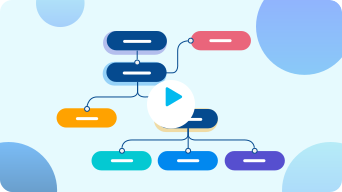
Recurring Text messages are a subset of scheduled text messages. They allow you to create your messages and then choose when they will be sent out on a regular basis -- daily, weekly, monthly, or whatever interval you choose. You can improve these messages based on dynamically changing conditions of a target group as situations change while they are receiving canned messages. Just be sure to keep to the promised message count, as regulators may crack down on you if you don't.

Key Function: Recurring messages are especially effective for things like meeting reminders, sales calls, or online and store sales.

Appointment Reminders

Appointment Reminders

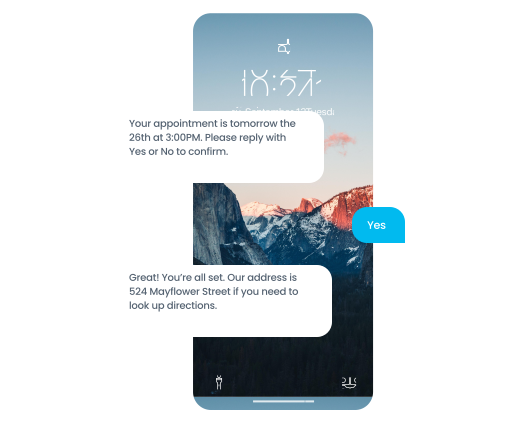
One extremely helpful and effective way to use SMS automation tools is by setting up appointment reminders that target specific users or groups. Every office or HR department knows how frustrating it can be when appointments get canceled or no-shows occur. That is why appointment reminders can help confirm or reschedule appointments in order to save you and your company time.

Key Function: Rescheduling through Trum·pia is very easy too—contacts just need to text you and ask for a new appointment date, which can trigger a message that sends them a link to reschedule.

Link Tracking and Scoring

Link Tracking and Scoring: Data-Driven Audience Engagement

This powerful feature of our software automatically assigns scores to contacts based on the behavior and interactions they take in our system. This means your most qualified leads will receive the highest scores, helping you to determine who to target the most. We offer various ways to track customer interactions, which you can use to score them.

  • Site Tracking

    Allows you to tell when a contact has visited certain web pages or performed a specific action on your website. You can then use this information to segment your audience and target them. For instance, you can send a follow-up message to a customer who has visited your pricing page, but then send a different message to a customer who visited your tutorial videos.

  • Click-Through Tracking

    Lets you embed links into your texts and emails. Trum·pia then automatically tracks who did or didn't click on which links, letting you use this information to better target your next round of messages.

  • Lead Scoring

    Automatically assigns scores to your contacts based on the behavior and attributes they take within our system. Contacts can also accumulate scores in different categories.

  • Automated Workflows

    Set up a unique Workflows that activate when someone hits a certain score in a category. For example, for a nonprofit, if a contact scores 10 points for interest in volunteering in their community, we can automatically send them a link detailing your upcoming volunteer event schedule.

Simple SMS Automation vs Advanced Automated Workflows

To illustrate the difference between simple text automation and our advanced Automated Workflows, we can look at an example surrounding sending a reminder to fill out HR paperwork to a group of new hires. With a simple text automation service, the most you could do is schedule a reminder to be sent to all the new employees the day before the form is due. But with Trum·pia's SMS marketing tools, you can do a lot more.

Simple Text Automation vs Advanced Automated Workflows image

An Example of Advanced Automation

To begin, you can ask each employee more about them, like which position they are hired for and in which state.

Different roles may require different forms, so this allows you to automatically send them only the forms they need.

Then, you can track who has filled out their forms so you can send specific reminders to only those who still need to fill theirs out.

Lastly, sit back and enjoy the hours of time you saved.

This string of interactions makes Trum·pia's Automated Workflows so powerful. Whereas a simple automation service still requires loads of manual intervention at each step, Trum·pia's automated texting service can fully automate the entire engagement with free-form, omnidirectional workflows.

How Automated Texting Works with Integrations

To make the most out of your customer's data, you may want to integrate your applications with Trum·pia so that they work together. If you have an in-house development team, they may be able to build some integrations yourself, but that could eat into their valuable coding time for other priority projects. If you don't have a development team or your team is busy, there are some other great options. 

Integrating texting with other programs leads to more effective messaging and less data entry Integrating texting with other programs leads to more effective messaging and less data entry

Using an Integration Platform

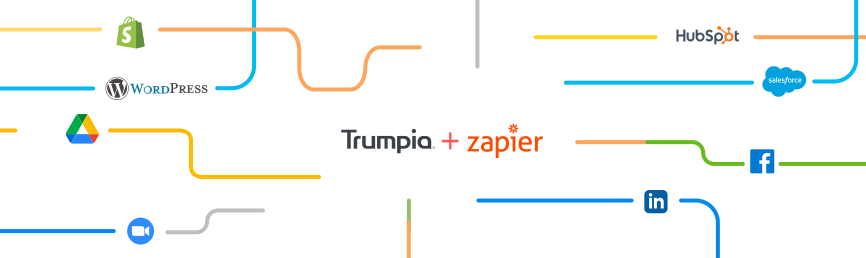
Integration platforms like Zapier allow you to connect different programs together so that they trigger off of each other, turning your unconnected programs into an interconnected web. This applies to your customer relationship management programs (CRMs) too. Applications like Salesforce allow you to integrate different applications and messaging channels into one easy-to-use interface.

API Integrations

And of course there are always API integrations. Implementing a multichannel API into your programs allows you to scale up to thousands of messages that you can send customers across any channel you'd like.

Trum·pia's API Advantage: Powerful, Organized, Secure

  • With Trum·pia's API, you get powerful database management. This way, you don't have to write code to create lists, add contacts, update them, or even unsubscribe them. It's almost like having a built-in CRM at no additional cost.

  • Quickly increase login security with our 2-factor authentication tool. This secures your software or website by requiring a one-time passcode that's either emailed or texted to users.

  • Trum·pia's API service supports dedicated short codes and toll-free number options. Both come with high throughput, but toll-free costs $1,000s less.

Getting Started with Text Message Automation

Text automation works wonders, but it can't do anything if you do not have contacts to send messages to. So, to get started, here are a few simple steps you should take.

  • 1. Sign Contacts Up

    When you want to get started with text automation, the first thing you have to do is build a contact list. Regulations say you have to have consent from your contacts before you can message them. There are 3 easy ways to do this:

    1. 1.

      Mobile keywords allow your contacts to opt in to your campaigns. You can capture their phone number and send them automated text messages. A mobile keyword can be any word you select for your customers to text so they can subscribe to your alerts. When a customer texts in your keyword, a text messaging software will automatically capture their phone number and store it in your database.

    2. 2.

      Online signup pages let your customers opt themselves in to receive your messages by filling out their information and giving you consent to send them automated text messages.

    3. 3.

      Outside Trum·pia, you can also sign up existing contacts for automated text messages provided you have their express written consent to do so. You can then import this to your text automation software easily.

  • 2. Best Practices to Get Signups

    Once you've decided that you would like to use an automated messaging service like Trum·pia, you'll need to build your database so that you can reach as many potential customers as possible. While that may seem daunting, there are a number of easy ways to beef up your subscriber list. Here are a few:

    • Make Subscribing Easy (Keep It Simple)

      Potential subscribers aren't going to jump through hoops to join your automated text messaging lists. If it's not easy to subscribe, they won't spend the time to figure it out. You can make signing up as easy as texting your keyword to a designated number, automatically opting themselves into your messaging lists. Then if you have a service like Trum·pia, we can automatically ask them more questions to learn more about them.
    • Make Subscribing Appealing (Offer Incentives)

      Simply being able to get all of the latest information about your organization probably isn't enough to entice most people to subscribe to your mass texting program. Instead, consider offering a drawing for some kind of prize or gift certificate from all of the subscribers during a specific period or during a vendor event. Or you can offer anyone who signs up a coupon or exclusive deal, like 20% off their next purchase.
    • Expand Your Presence (Use Multiple Channels)

      You never know where a potential customer will first notice your company. It could be on your website, on social media, or even in print advertising. Be sure to have a way for all of these readers to sign up. Just because a potential customer is reading your brochure doesn't mean that they don't use text messaging. To simplify this, you can put your mobile keyword across all of your forms of advertising so that they can easily sign up, no matter where they are.

Automatin Text Messaging Frequently Asked Questions

How do Trumpia's Automated Workflows ensure immediate, compliant processing of STOP and HELP keywords?

Our platform features mandatory and instantaneous automated opt-out processing, which immediately removes contacts who text STOP from all active and future campaigns, ensuring strict SMS compliance workflow adherence. The system also handles HELP keyword handling by instantly sending a mandated message detailing contact information and message frequency.

What are the system's throughput limits and message queuing strategies for sending time-sensitive bulk automations?

Trumpia utilizes high-speed SMS throttling and intelligent message queuing to manage high-volume spikes, ensuring that time-sensitive campaigns, even those using long codes, achieve optimal high-volume delivery rates without significant message latency. The platform prioritizes automated transactional messages over marketing blasts during periods of high load to maintain performance.

Beyond open and click-through rates, what advanced reporting metrics are available to analyze automated journey performance?

Advanced reporting offers SMS funnel analytics to visualize drop-off points, path performance tracking to compare the success of branching workflows, and deep segmentation to calculate the exact automation conversion rate for different target groups. These metrics allow marketers to pinpoint which messages are driving the highest ROI within the entire customer journey.

Does Trumpia offer native, two-way sync integrations for platforms like HubSpot or Pardot to trigger workflows?

Yes, our platform provides robust marketing automation integration through API and direct connectors for major CRMs like HubSpot, enabling two-way data sync to trigger a text message workflow based on a CRM status change. This allows you to automatically enroll contacts in a text sequence the moment they move to a specific stage in your sales or nurture funnel.

How can I set up message frequency capping within a workflow to prevent contacts from being over-messaged and avoid budget overruns?

You can implement message frequency capping rules globally or within specific workflow steps, allowing you to define a subscriber saturation limit, such as no more than two texts per week, for any given contact. This automated budget control feature ensures a positive user experience and prevents unnecessary messages that lead to high opt-outs and budget overruns.

How does a webhook integrate with Trumpia's platform to trigger an automated SMS campaign?

A webhook acts as an instant, external trigger—when a specified event occurs in another system (like a new sale in your e-commerce platform), a real-time signal is sent to Trumpia's platform to immediately begin a pre-defined transactional SMS workflow. This is the fastest way to achieve event-driven automation and eliminates the need for constant, time-consuming API polling.

What are the best practices for documenting TCPA consent when using automated text workflows?

TCPA compliance best practices require you to maintain detailed, timestamped records of a subscriber's express written consent method, including the date, time, and specific disclosure language they agreed to. Trumpia helps automate this consent management process by logging the details of all opt-ins to provide a robust legal defense in case of an audit.

Can the system automatically calculate and adjust for a recipient's local time zone when scheduling a message?

Yes, Trumpia’s time zone scheduling feature is crucial for maintaining SMS compliance and improving engagement, as it automatically sends the message within the recipient's local time window (e.g., 9:00 AM) regardless of where the sender is located. This prevents messages from being delivered during prohibited hours, which is vital for respecting privacy and TCPA regulations.

What is the difference between a Dynamic Target and a fixed contact group in the automation system?

A Dynamic Target is a smart, filtered segment whose member list automatically updates in real-time based on continually changing customer data and behavior, while a fixed group requires manual updates. This real-time segmentation ensures that every automated message is sent only to the currently qualified audience, maximizing relevance and list hygiene.

How can I use lead scoring to automatically move high-value prospects into an advanced text campaign?

You can assign lead scoring values to specific actions, such as clicking a high-intent link or visiting the pricing page, and then set an automated workflow trigger to enroll the prospect in an advanced nurturing SMS sequence once their score reaches a specific threshold. This behavioral automation ensures your sales team is only notified when a contact is genuinely hot.